PTFE

Tubes

Precision Manufactured for Demanding Applications

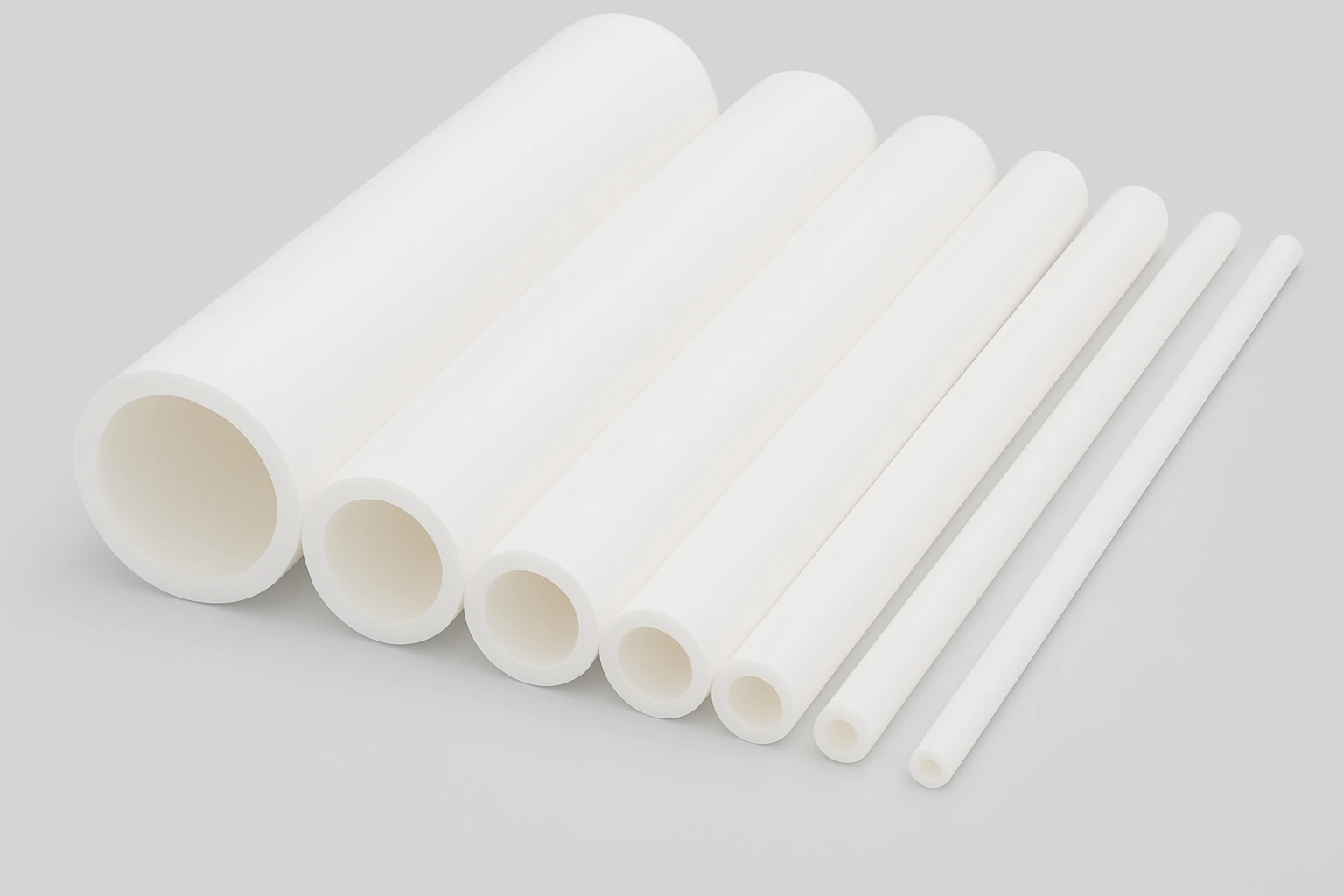
XIFLON PTFE XF100 MOLDED TUBES are semi-finished products made by cold compression molding of virgin PTFE, then sintered for dimensional stability. Built for machining and insulation, they offer strong walls, uniform properties, and dependable performance.

Chemical Resistance

Resists acids, bases, and solvents; suited to harsh processing and clean machining.

Thermal Stability

Reliable across −200 °C to +260 °C; steady under thermal cycling.

Dielectric Properties

High dielectric strength for dependable insulation and barriers.

Low Friction & Wear

Very low friction supports smooth sliding and long service life in parts.

Experience Unmatched Performance In Extreme Conditions

Precision ram-extruded PTFE tubes for clean fluid handling and long-term reliability in aggressive media.

Contact Us

HOW OUR PTFE XF100 MOLDED TUBES ARE PRODUCED

Optimize Your Process With Precision‑Engineered Performance

Contact Us

Our PTFE molded tubes are produced by cold compression molding followed by controlled sintering to reduce porosity and lock in geometry. The result is a dense, stable blank ready for precision parts in harsh service.

Low Porosity

Sintered, dense PTFE helps ensure clean seals and vacuum-ready parts.

Load Strength

Heavy walls support seats, bushings, and wear rings under static loads.

Consistent Wall

Uniform wall distribution yields predictable machining and fit.

Short-Length Blanks

Molded tube blanks supplied ready for turning, boring, and close-tolerance finishing.

DIMENSIONS & TOLERANCES - PTFE XF100 MOLDED TUBES

OD, mm ID, mm Length, mm
min max min max min max
12 2000 5 1295 50 300

DIMENSIONS & TOLERANCES - PTFE XF100 MOLDED TUBES

OD, mm Tolerance
ID OD
≥ 10 mm −6 % / 0 0 / +6 %
Length, mm Tolerance
< 500 mm 0 / +10 mm

PTFE PRODUCTS FROM XIFLON

OPTIMIZE YOUR PROCESS WITH PTFE XF100 MOLDED TUBES

This advanced cold compression molding route produces heavy-walled PTFE molded tubes, then sintered for uniform properties and dimensional stability. Combining chemical inertness, a −200 °C to +260 °C service window, very low friction, and high dielectric strength, XF100 molded tubes suit valve seats, gaskets, insulators, bushings, and other precision parts.

  • Standard dimensions: OD 12–2000 mm, ID 5–1295 mm, length 50–300 mm; cut-to-size available.
  • Dimensional tolerances to ISO 13000-1: ID ≥10 mm −6%/0; OD 0/+6%; length <500 mm 0/+10 mm.

Applications: Seals, gaskets, valve parts for pumps and process equipment.

Applications: Seals, gaskets, valve parts for hygienic processes.

Applications: Insulators, spacers, dielectric components.

Applications: Bushings, bearings, custom parts for corrosive media.

Applications: High‑purity precision components with smooth finishes.

Applications: Hygienic seals, fittings, and machined parts for tanks and processing equipment.

XIFLON PTFE MOLDED TUBES : CERTIFIED FOR GLOBAL STANDARDS & COMPLIANCE

Regulatory Compliance

REACH – SVHC‑free as per EC 1907/2006 (latest Candidate List).
RoHS – Compliant with Directive (EU) 2015/863.
FDA – Compliant with FDA 21 CFR 177.1550 for food contact applications.

Certification

Certification

ISO_9001-2015
1
reach-compliance
rohs
ASTM

WHY CHOOSE XIFLON PTFE XF100 MOLDED TUBES ?

i

Key Advantages

Versatile Sizes

OD 12–2000 mm, ID 5–1295 mm, length 50–300 mm; cut-to-size on request.

Molded Integrity

Cold compression molded, then sintered for structural integrity and uniform heavy walls.

High Performance

Chemical resistance, low friction, and dielectric insulation; service −200 °C to +260 °C.

Expert Support

Help with OD/ID selection and machining blanks for seats, gaskets, bushings, and insulators.

Standards & Tolerances

ISO 13000-1: ID ≥10 mm −6%/0; OD 0/+6%; length <500 mm 0/+10 mm.

Need Assistance?

Our PTFE team can advise on sizes, machining allowances, and part design for molded blanks.

Contact Our Team

Technical Resources

See the Molded PTFE Tubes size ranges and ISO tolerance tables.

Download Guide

PTFE XF100 MOLDED TUBES FAQ

PTFE tubes (Polytetrafluoroethylene tubes, also known as Teflon® tubes) are hollow semi-finished fluoropolymer products valued for their exceptional chemical resistance, non-stick properties, and wide operating temperature range.

Unique advantages of PTFE tubes:

  • Continuous service temperature: -200 °C to +260 °C
  • Inert to almost all industrial chemicals
  • Ultra-low friction surface → excellent for fluid flow
  • Excellent dielectric insulation → ideal for electrical sleeving
  • Non-stick and non-wetting → prevents clogging or fouling
  • FDA- and USP-compliant grades available

 In short: PTFE tubes are the go-to choice for fluid transfer, insulation, and sealing in harsh environments.

PTFE tubes are produced by two main methods:

Extruded PTFE tubes (ram-extruded):

  • Manufactured by ram extrusion (since PTFE is not melt-processable)
  • Available in small to medium diameters (1 mm – 150 mm ID)
  • Supplied in long continuous lengths
  • Flexible, smooth, and excellent for fluid transfer and insulation

Molded PTFE tubes (hollow billets):

  • Manufactured by compression molding + sintering
  • Available in large diameters (up to 600 mm ID)
  • Supplied in short billets (100 – 300 mm long)
  • Rigid and dense, ideal for machining into seals, valve seats, and gaskets

 Summary:

  • Use extruded PTFE tubes for fluid transfer, insulation, and long-length tubing
  • Use molded PTFE tubes for machined components and heavy-duty applications

PTFE tubes are supplied in a wide range of diameters and lengths.

Extruded PTFE tubes:

  • Inner diameter (ID): 1 mm – 150 mm
  • Wall thickness: 0.1 mm – 10 mm
  • Lengths: Continuous extrusion, standard 1000 – 2000 mm, or coiled

Molded PTFE tubes:

  • Inner diameter (ID): 20 mm – 600 mm
  • Wall thickness: up to 50 mm
  • Lengths: Typically 100 – 300 mm billets

Custom options:

  • Etched PTFE tubes → for bonding with adhesives
  • Pigmented grades → black, grey, or custom colors
  • Filled PTFE tubes → glass, carbon, or bronze-filled for added strength and wear resistance

 From microbore tubing to large hollow billets, PTFE tubes cover nearly every size requirement.

PTFE tubes are used in industries requiring extreme chemical resistance, thermal stability, and non-stick performance.

Industries & uses:

  • Chemical processing → Acid/solvent transfer lines, pump liners, valve seats
  • Electronics & semiconductors → Insulating sleeves, dielectric tubing, wafer handling systems
  • Medical & pharmaceutical → Catheters, sterile tubing, biocompatible fluid transfer lines
  • Food & beverage → FDA-approved non-stick transfer tubing
  • Aerospace & automotive → Lightweight hydraulic/fuel conduits, wire insulation, sealing elements

 PTFE tubes are indispensable for industries where other plastics fail under heat or chemicals.

Temperature resistance:

  • Continuous service up to 260 °C
  • Cryogenic stability down to -200 °C
  • Resistant to thermal cycling and outdoor weathering

Wear & friction:

  • Ultra-low friction → smooth fluid flow, self-lubricating
  • Moderate wear resistance (improved with glass, carbon, or bronze fillers)
  • Tendency to creep under long-term load

Chemical resistance:

  • Inert to almost all chemicals, acids, bases, and solvents
  • Non-aging and UV-resistant
  • Not resistant to molten alkali metals or elemental fluorine

 PTFE tubes excel in corrosive, high-heat, and low-friction applications, though filled grades are preferred for load-bearing use.

PTFE vs. PFA tubes:

  • Both resist up to 260 °C
  • PTFE → opaque, softer, non-melt-processable
  • PFA → transparent, weldable, more stress-crack resistant

PTFE vs. FEP tubes:

  • FEP → transparent, flexible, extrudable, service up to 200 °C
  • PTFE → opaque, higher heat resistance, better creep resistance

PTFE vs. PVDF tubes:

  • PVDF → tougher, more rigid, cost-effective, up to 150 °C
  • PTFE → chemically superior, non-stick, up to 260 °C

 Summary:

  • Choose PTFE tubes → for maximum chemical resistance and non-stick performance
  • Choose PFA tubes → for high-purity weldable applications
  • Choose FEP tubes → for clarity and flexibility under moderate heat
  • Choose PVDF tubes → for tough, outdoor, and cost-sensitive applications

Yes — PTFE tubes are widely used as machining stock for seals and insulating parts.

Machining benefits:

  • Machines cleanly with sharp tools
  • Soft material requires care to avoid creep or deformation
  • Produces smooth surface finishes

Fabrication options:

  • Etching → surface treatment for adhesive bonding
  • Cutting & shaping → die-cut gaskets, custom rings, precision parts
  • Filled PTFE tubes → enhanced wear resistance and load-bearing capacity

Common machined parts from PTFE tubes:

  • Valve seats and pump liners
  • Bushings and spacers
  • Seals and back-up rings
  • Electrical insulators

 PTFE tubes are highly versatile and can be fabricated into durable sealing, insulating, and non-stick components.